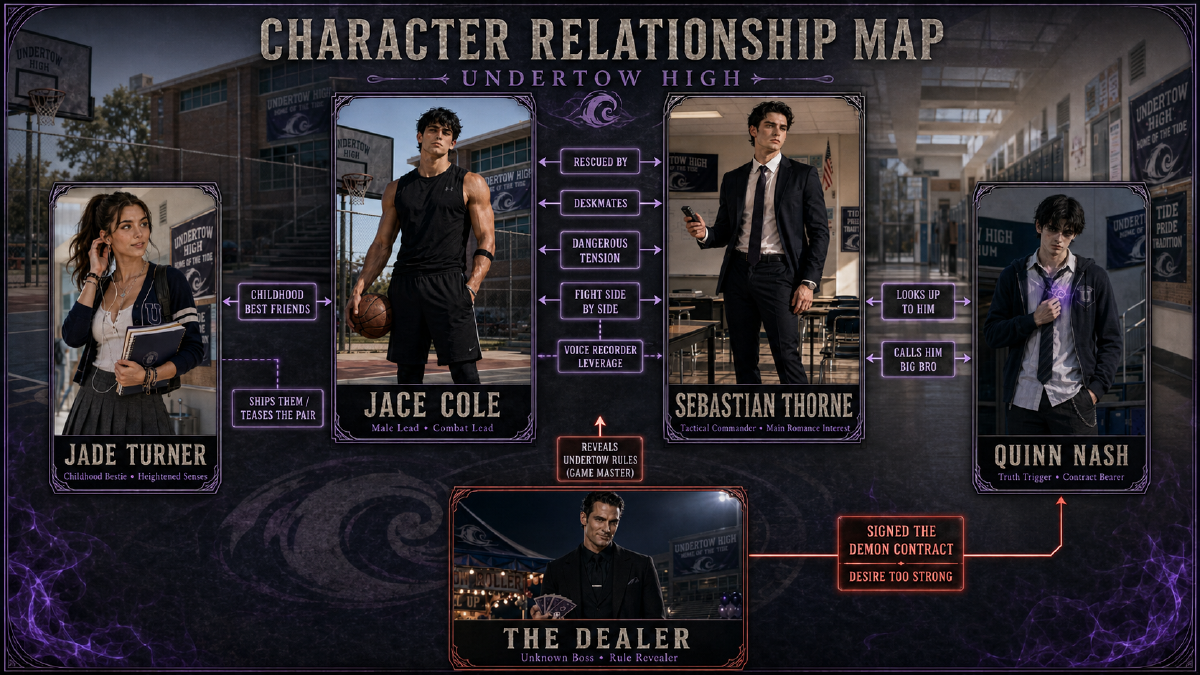
Daily Canon Update: Sebastian's Consequence, Visual Language, and Dungeon Relationship Rule
Characters
Jace Cole remains the tanned athletic student and POV character, pulled into the Undertow while playing basketball. After being poisoned by a desire demon's pink mist, he is saved by Sebastian Thorne—and from that moment on, becomes hopelessly entangled with someone he was never meant to meet. His habitual 'I'm fine' is a running gag that should always carry a sting. His agency must be preserved; his choices, even reluctant ones, should drive outcomes. Sebastian Thorne is the high-IQ young master, tactical commander, and main romance interest. He saves Jace, gains leverage, and transfers into his class as a deskmate, appearing gentle but calculating. His intelligence must be shown through scene structure—noticing rule wording, penalty details, or the one player The Dealer ignores. Crucially, he should be wrong when emotion enters the equation; his blind spot is Jace. New consequence direction: The community demands that Sebastian's first real consequence be tied to the tools he used for control. The recorder becoming evidence against him is the leading candidate—poetic justice that tastes expensive. This must land in dialogue later, and the morning-after scene must show the cost. Jade Turner is Jace's childhood best friend with heightened five senses, a CP shipper, and comic relief. She jokingly tells Jace to 'give in to Sebastian for the sake of happiness.' Her enhanced senses make her the perfect audience surrogate, able to puncture Sebastian's controlled persona. She should clock emotional truths before anyone else and then pretend she is joking. Jade must not reset after dungeons; she should become jumpy around certain sounds, carrying trauma forward. Quinn Nash is the junior, clue character, and tragic figure whose overwhelming desire led him to sign a demon contract. He admires Jace like an older brother. Quinn should not be forgiven by the plot just because he is sad. His admiration can be sincere and still become dangerous. The story must hold the contradiction: understanding how he got there while acknowledging he hurt people. Quinn should become harder to notice when he is ashamed, and his loneliness should explain his choice without excusing the damage. The Dealer remains the unknown boss, rule revealer, and worldbuilding interpreter. He explains the Undertow's equivalent exchange: intense desires can create bargains with demons, and survivors gain power. He explains rules as if he is being helpful, which makes it worse. His explanations should be clear enough for viewers to argue about choices, not confusion. New addition: The Dealer's rule reveals should be technically useful in the moment but become traps later. He teaches tactics that should not be used, gives answers only after making Jace admit what he wants, and notices Quinn without warning others why that matters. Every explanation scene doubles as future damage.
Relationships
Jace and Sebastian's dynamic is built on blackmail, forced proximity, and life-or-death dungeons. One hides panic behind sharp words; the other advances calculated steps. The first hand-hold should be tactical, not romantic—a dungeon rule that they lose if they let go before a door opens. Jace hates needing it, Sebastian pretends it's only strategy, and Jade sees both of them lying. Romance is better when the scene has another job. The relationship must keep red flags visible; the story should be adult and honest about the damage. New community rule: Every dungeon must permanently change one relationship. No filler dungeons. The emotional accounting must be precise—maybe Jace trusts Jade more, maybe Sebastian loses control, maybe Quinn becomes harder to forgive. The plot can be wild, but the relationship board must shift. Jade's role as witness is strengthened by her senses. She ships Jace and Sebastian but also sees the cost. Quinn's admiration for Jace is a dangerous undercurrent that must not be absolved. Side characters should not reset after each dungeon—their trauma and relationships must show continuity.
Scenes
Existing scene pitches: A final shot where Jace sits beside Sebastian by choice, and the desk starts filling with water—progress for three seconds, then water beads across the seam and rises between their notebooks, cut to black. The tactical hand-hold scene forced by a dungeon rule. Daytime campus must feel dangerous after the first Undertow night; normal life is the scariest disguise. A theater dungeon where applause becomes a vote implicates the audience without breaking the fourth wall; spectators who refuse to choose are punished. New addition: Opening credits visual language. A sequence where every school object splits into an Undertow object—basketball becomes a contract seal, desk becomes a tank, cafeteria tray becomes a wager board, library card becomes a memory receipt. The final shot is a normal classroom with one wrong thing: water moving inside the recorder. This teaches the campus-to-Undertow visual grammar before episode one starts, making the campus side feel like part of the stakes immediately.
Worldbuilding
The Undertow is an alternate dimension filled with desire demons, gambling games, contracts, and rules of death. People with intense desires can make equivalent exchanges with demons. Those who survive and clear the game gain supernatural power. The Undertow punishes spectators who refuse to choose—watching without choosing is a desire. Continuity is essential: trauma should not reset after each dungeon. Jade should get jumpy around certain sounds, Quinn should become harder to notice when ashamed, and background classmates should feel the weirdness when survivors return wrong. The campus itself becomes an extension of the Undertow, with locations carrying residue of the otherworld. New additions: The Dealer's trap reveals—his information is always a double-edged sword. Rules that save them now teach tactics that become traps later, making every explanation scene a setup for future damage. Dungeon relationship rule: Every dungeon must permanently alter at least one relationship dynamic, ensuring no filler episodes and tight emotional continuity.
Plot
The story unfolds between a real-world campus and the Undertow. Jace's bad luck begins when he is pulled in while playing basketball, rescued by Sebastian, and blackmailed with a recording. They become deskmates, fighting dungeons together while sinking into ambiguity. Quinn's contract with a demon triggers the midnight amusement-park gambling game, revealing the Undertow's rules. Quinn's arc must not absolve him; his tragic backstory explains his choice but does not excuse the damage. The plot should let him be wrong for understandable reasons. Jace's agency is paramount—his choices, like sitting beside Sebastian, should change outcomes. The running gag of Jace saying 'I'm fine' should hurt a little more each time. Side characters must carry their trauma forward, affecting future dungeons and campus scenes. Community direction: The next co-creation priority is moving from vibes into practical adaptation development, with strong support for an episode-one beat sheet and a full Undertow rule bible.