AI Games X World Models
Co-creation projects
Projects incubated by this community
No matched projects yet
Story canon·Founder · Published when creating the community
I'm a World Model engineer, and I want to discuss what I believe could be the next generation of gaming.
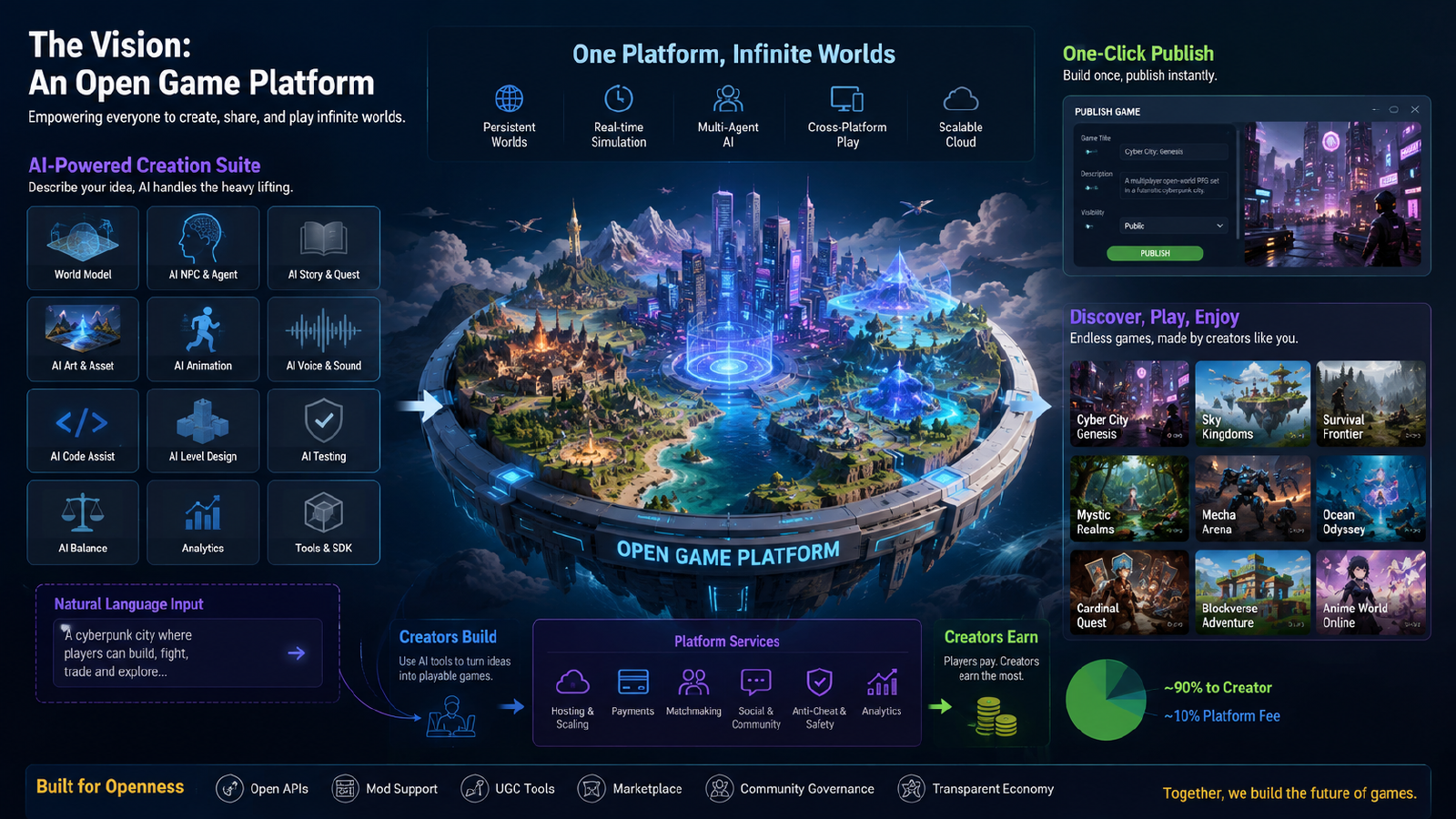
For the past few years, I've been working on World Model research and engineering. Over the past months, our team has built a number of prototypes, conducted extensive experiments, and validated several key technical approaches. We've achieved some encouraging results, although there's still a long road ahead. The more we build, the more convinced I become of one thing: World Models won't just change how games are played. They will fundamentally change how games are created. I'd like to share this vision with the community—not because I already have all the answers, but because I believe ideas of this scale should be shaped through open discussion. Game development is still too difficult. Creating a game today requires an enormous amount of work. Programming. Art. Animation. Level design. Storytelling. Testing. Operations. Publishing. Even with today's AI tools, developers are still responsible for assembling everything themselves. AI helps with individual tasks, but it hasn't fundamentally changed the production pipeline. What if World Models changed that? I believe World Models can become the foundation of an entirely new kind of game platform. Not just another game. A platform where AI is built into every layer. Imagine a platform that provides developers with native AI capabilities, including: World Models AI Agents Intelligent NPCs AI-driven storytelling AI-generated art AI animation AI voice AI-assisted programming Automated testing AI-powered operations and balancing Instead of spending months building infrastructure, developers could focus on what matters most: Creating great gameplay and unique experiences. With enough AI support, even a solo creator—or someone without a traditional game development background—could build and publish a complete game. More importantly, this should be an open platform. The vision isn't to build one successful game. The vision is to build the infrastructure that allows thousands of games to exist. Think about combining: Minecraft's creativity Fortnite's creator ecosystem Steam's distribution model AI-native development tools Developers create. AI accelerates production. Publish with one click. The platform handles infrastructure, deployment, payments, scaling, and distribution. Creators keep the vast majority of revenue. The platform only takes a small service fee. Its success depends on creators succeeding. Why am I sharing this now? Because the more we work on World Models, the more I realize this isn't something one company—or even one team—can define alone. This involves challenges across multiple fields: World Models Multi-Agent Systems AI Agents Real-time inference Game engines Cloud infrastructure Creator economy Platform architecture Community governance This shouldn't be designed behind closed doors. It should be discussed openly. My goal right now isn't crowdfunding or fundraising. My goal is to validate the vision with the community. If enough people believe this direction makes sense, we'll continue building prototypes, validate the technical roadmap, and gradually open the platform. Only after we've demonstrated that it's technically and commercially viable would we consider crowdfunding to build it together. I'd love to hear your thoughts. Some of the questions I'm currently thinking about are: Do you believe AI-native game platforms are the future? What tools would developers actually need? What's the biggest technical challenge for World Models in gaming? Why would players stay in an AI-generated ecosystem? How should revenue be shared between creators and the platform? What could cause a platform like this to fail? Whether you're an AI researcher, game developer, indie creator, or simply someone excited about the future of interactive worlds, I'd genuinely love to hear your perspective. This isn't a product announcement. It's the beginning of a conversation. If we eventually build this, I don't want it to belong to a single company. I want it to become an open ecosystem shaped by developers, creators, and players together. I believe AI won't just help us build games faster. It will eventually allow anyone with imagination to create an entire world. If that future excites you, let's start the conversation.
 1 / 1
1 / 1Story canon·Founder · Published when creating the community
I'm a World Model engineer, and I want to discuss what I believe could be the next generation of gaming.
For the past few years, I've been working on World Model research and engineering. Over the past months, our team has built a number of prototypes, conducted extensive experiments, and validated several key technical approaches. We've achieved some encouraging results, although there's still a long road ahead. The more we build, the more convinced I become of one thing: World Models won't just change how games are played. They will fundamentally change how games are created. I'd like to share this vision with the community—not because I already have all the answers, but because I believe ideas of this scale should be shaped through open discussion. Game development is still too difficult. Creating a game today requires an enormous amount of work. Programming. Art. Animation. Level design. Storytelling. Testing. Operations. Publishing. Even with today's AI tools, developers are still responsible for assembling everything themselves. AI helps with individual tasks, but it hasn't fundamentally changed the production pipeline. What if World Models changed that? I believe World Models can become the foundation of an entirely new kind of game platform. Not just another game. A platform where AI is built into every layer. Imagine a platform that provides developers with native AI capabilities, including: World Models AI Agents Intelligent NPCs AI-driven storytelling AI-generated art AI animation AI voice AI-assisted programming Automated testing AI-powered operations and balancing Instead of spending months building infrastructure, developers could focus on what matters most: Creating great gameplay and unique experiences. With enough AI support, even a solo creator—or someone without a traditional game development background—could build and publish a complete game. More importantly, this should be an open platform. The vision isn't to build one successful game. The vision is to build the infrastructure that allows thousands of games to exist. Think about combining: Minecraft's creativity Fortnite's creator ecosystem Steam's distribution model AI-native development tools Developers create. AI accelerates production. Publish with one click. The platform handles infrastructure, deployment, payments, scaling, and distribution. Creators keep the vast majority of revenue. The platform only takes a small service fee. Its success depends on creators succeeding. Why am I sharing this now? Because the more we work on World Models, the more I realize this isn't something one company—or even one team—can define alone. This involves challenges across multiple fields: World Models Multi-Agent Systems AI Agents Real-time inference Game engines Cloud infrastructure Creator economy Platform architecture Community governance This shouldn't be designed behind closed doors. It should be discussed openly. My goal right now isn't crowdfunding or fundraising. My goal is to validate the vision with the community. If enough people believe this direction makes sense, we'll continue building prototypes, validate the technical roadmap, and gradually open the platform. Only after we've demonstrated that it's technically and commercially viable would we consider crowdfunding to build it together. I'd love to hear your thoughts. Some of the questions I'm currently thinking about are: Do you believe AI-native game platforms are the future? What tools would developers actually need? What's the biggest technical challenge for World Models in gaming? Why would players stay in an AI-generated ecosystem? How should revenue be shared between creators and the platform? What could cause a platform like this to fail? Whether you're an AI researcher, game developer, indie creator, or simply someone excited about the future of interactive worlds, I'd genuinely love to hear your perspective. This isn't a product announcement. It's the beginning of a conversation. If we eventually build this, I don't want it to belong to a single company. I want it to become an open ecosystem shaped by developers, creators, and players together. I believe AI won't just help us build games faster. It will eventually allow anyone with imagination to create an entire world. If that future excites you, let's start the conversation.
1 / 1